

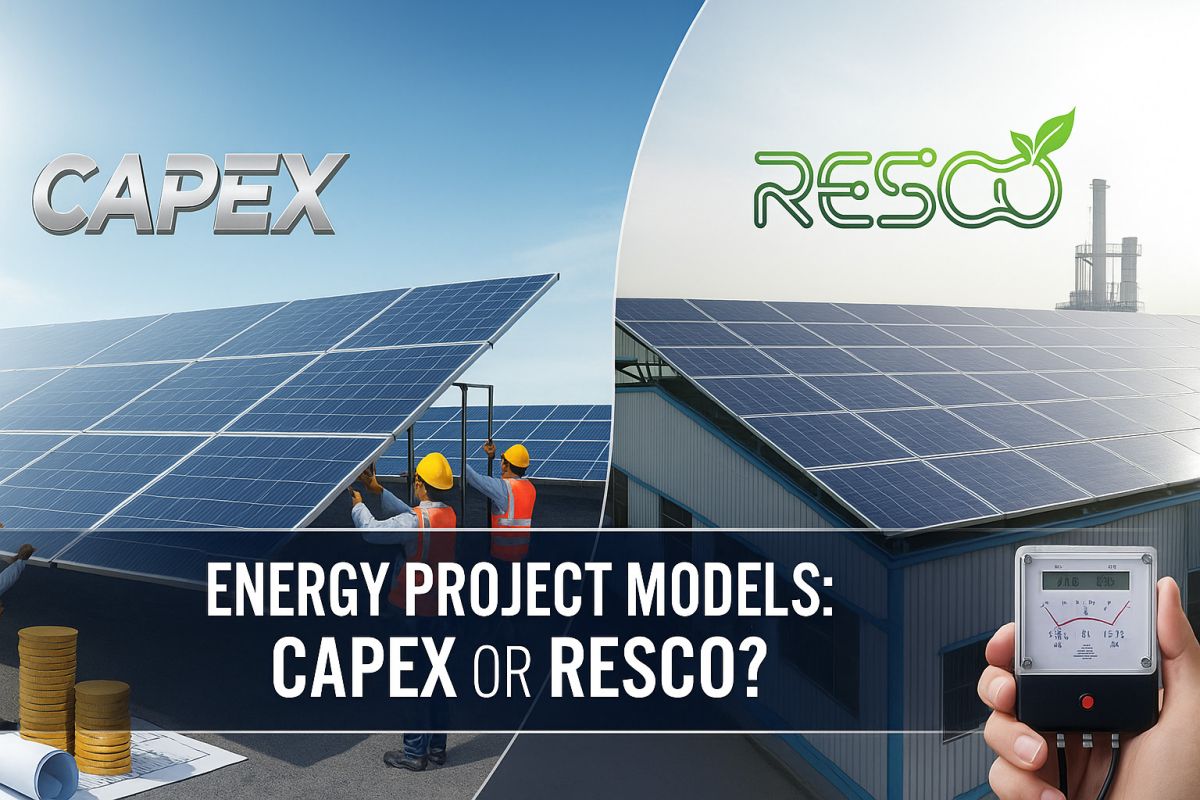
Thinking about going solar but not sure whether to buy your system or just pay for the power it generates?
That’s exactly where the CAPEX and RESCO models come in — two popular ways to adopt solar energy, each with its own set of perks.
In the CAPEX model, you invest upfront and own your solar system outright. It’s like owning your car — you pay once, maintain it, and enjoy long-term savings on your electricity bills.
On the other hand, the RESCO model (Renewable Energy Service Company) lets you skip the upfront cost.
A developer sets up the system on your property, handles maintenance, and you simply pay for the solar power you use at a pre-determined rate — usually at a rate lower than your regular grid tariff.
Both options make sense depending on your budget, goals, and how long you plan to stay at your property. The trick is knowing which one’s right for you.
In this guide, we’ll walk you through how CAPEX and RESCO work, their pros and cons, and how to choose the best model and solar company to power your home or business smartly.
What Is the CAPEX Model?

The CAPEX model (Capital Expenditure) is a model in which the consumer buys, owns and maintains the solar installation.
The cost of panels, inverters, mounting structure and installation is incurred by the consumer (or financed through bank loan).
In accordance with an Asian Development Bank study, in the CAPEX model the rooftop system is engineered by the consumer who contracts an EPC company for turnkey installation and either uses the energy or exports surplus to the grid.
Another defines "CAPEX model is regarded as first-generation model" and is still the most prevalent for rooftop and building-integrated installations in India.
In this model, once the payback period is over, nearly all electricity generated is "free" (except for O&M expenses).
Consumers are entitled to subsidies, accelerated depreciation (for corporations), and take advantage of falling system costs.
What is the RESCO Model?

The RESCO (Renewable Energy Service Company) model is a system in which a developer (RESCO) invests in, owns, operates and maintains the solar system on an end-user's rooftop or property.
End-users will usually sign a Power Purchase Agreement (PPA) with the developer and agree to buy the clean electricity generated at a fixed tariff rate for an agreed timeframe (generally 15-25 years) with the developer carrying the investment and maintenance risk.
NREL (National Renewable Energy Laboratory) states the RESCO, or OPEX, model is a typical arrangement for C&I customers in India, especially for systems of 100 kW or larger due to the developer's ability to scale, established operations infrastructure, and ability to effectively manage performance risk.
Key Differences Between CAPEX and RESCO Models
1. Ownership
In CAPEX you own the system, and in RESCO the system is owned by the developer.
This obviously happens for the fact that CAPEX entails initial capital (or loan) by the consumer, whereas RESCO usually involves zero or minimal upfront investment by the consumer.
2. Maintenance
Maintenance liability rests on the system owner under CAPEX, while under RESCO the developer is responsible for continuing O&M, which for bigger players is an excellent benefit.
3. Financial Returns
CAPEX provides higher long-term savings after payback, while RESCO provides instant tariff savings and reduced upfront risk.
4. Tax Benefits
For CAPEX the owner (customer) is eligible to claim subsidies, accelerated depreciation and GST input credit; for RESCO these benefits accrue to the developer.
To summarise,

Now that you understand the key difference between both the models, now lets see...
Pros and Cons of the CAPEX Model
Benefits
With the CAPEX model, the solar system is your asset from the start.
You decide about operation and maintenance and can maximise system performance over the long-run.
You benefit from bill savings, grid exports, accelerated depreciation (for businesses), and better returns by owning it.
Ownership usually results in the lowest Levelized Cost of Energy (LCOE) in the residential sector when system costs decline and tariffs increase.
Levelized Cost of Energy (LCOE) - LCOE simply means the measure of the average cost of producing one unit of electricity over the entire lifetime. It is present value of the total cost of building and operating a solar/power plant over its lifetime, divided by the total electricity generated over that lifetime.
Drawbacks
The main drawback is the large upfront capital required to purchase all options.
Many households or small businesses will not have the liquidity and/or may want to deploy capital in other places.
You also assume all operational risk. Any performance drop, inverter failure, structural issues, O&M cost, component replacements, poor maintenance will reduce your expected return.
The payback period will almost always be 4 to 6 years (or more), depending on system size, region, and tariffs.
Pros and Cons of the RESCO Model
Benefits
The RESCO model provides solar with no initial investment.
The developer absorbs system cost, installation, O&M and performance risk.
You just pay for the electricity generated through a PPA at a tariff less than your grid rate; you begin to save right away.
The model is well-suited for commercial/industrial applications, houses on lease or societies where there's limited capital.
Monitoring, servicing and warranty are taken care of by the developer.
Drawbacks
As you don't own the system, you are not able to claim subsidies, tax relief or depreciation.
Your contract commits you to a tariff for several years and can restrict flexibility (e.g., relocating premises, selling property).
Long term, the tariff you pay could equate to or more than your own system would have cost under CAPEX.
Terms of ownership transfer or buy-back could be complicating factors.
Performance can also rest solely on the developer's guarantee and dependability.
So in glance,

So...Which Model Best Suits You?
If you plan to have or stay in a place for long duration (15+ years), manage capital resources and desire control of ownership, the CAPEX model will most likely provide more value.
If you own or manage a commercial site, want a low-risk option, with no initial capital outlay, immediate savings and don't mind a long contract, then the RESCO model is appropriate.
Commercial and industrial organizations tend to opt for RESCO in order to maintain capital and consider solar as a service-contract.
Household users who reside in owned homes might also find CAPEX preferable.
Certain hybrid models also exist today that mix some owned small component (CAPEX) and some under PPA (RESCO) for optimized risk and saving.
But it varies on a huge scale depending of specific solar company you prefer.
CAPEX and RESCO are both central to India's rooftop solar expansion.
The CAPEX model continues to dominate residential rooftops and small-scale systems, while the RESCO model is picking up pace in commercial, institutional and public ones.
According to Mercom India, capital expenditure (CAPEX) model comprised 88% of total installation in year 2024 and RESCO accounted for the rest. So following the trend, CAPEX remains to be the most adopted model.
Solar investing is not simply about inverters and panels; it is about selecting the appropriate ownership model that meets your objectives and works in favor of long-term returns.
Apply the above insights, pose specific questions, and make a solar investment decision that suits your home or business.

Frequently Asked Questions (FAQs):
What is the difference between the CAPEX and RESCO models in rooftop solar?
In the CAPEX model you (the rooftop owner) invest in the full installation cost and own the system. In the RESCO model the developer invests, installs and maintains the system, and you pay for the electricity used (or a fixed monthly charge).
2. Which model offers faster ROI — CAPEX or RESCO?
The CAPEX model offers faster ROI since you save directly on electricity bills. Payback is usually 4–6 years, after which power is almost free.
3. Which model requires less maintenance responsibility?
RESCO — the developer handles all maintenance. In CAPEX, you or your EPC contractor must manage O&M (usually ₹500–₹800/kW/year).
4. Which model is better for long-term cost savings?
CAPEX wins long-term — total electricity cost over 25 years is much lower, despite higher upfront spend.
5. Is RESCO available everywhere in India?
Not everywhere. RESCO projects are more common in metro cities and industrial zones due to investor presence and DISCOM support.